Weekly Wrap: How do Europe’s mobile operators compare for 5G standalone deployment?
A new PolicyTracker white paper uses data from the recently released Mobile Deployment Database to compare 5G standalone deployments across Europe for Orange, Deutsche Telekom, Vodafone and Telefónica.
The Mobile Deployment Database contains data on 43 European countries, visualising operator-level deployments of national mobile spectrum assignments.
PolicyTracker has used the database to compare the extent to which Europe’s four major mobile operators – Vodafone, Telefónica, Deutsche Telekom and Orange – have made use of their 5G spectrum assignments and deployed 5G networks in their respective markets.
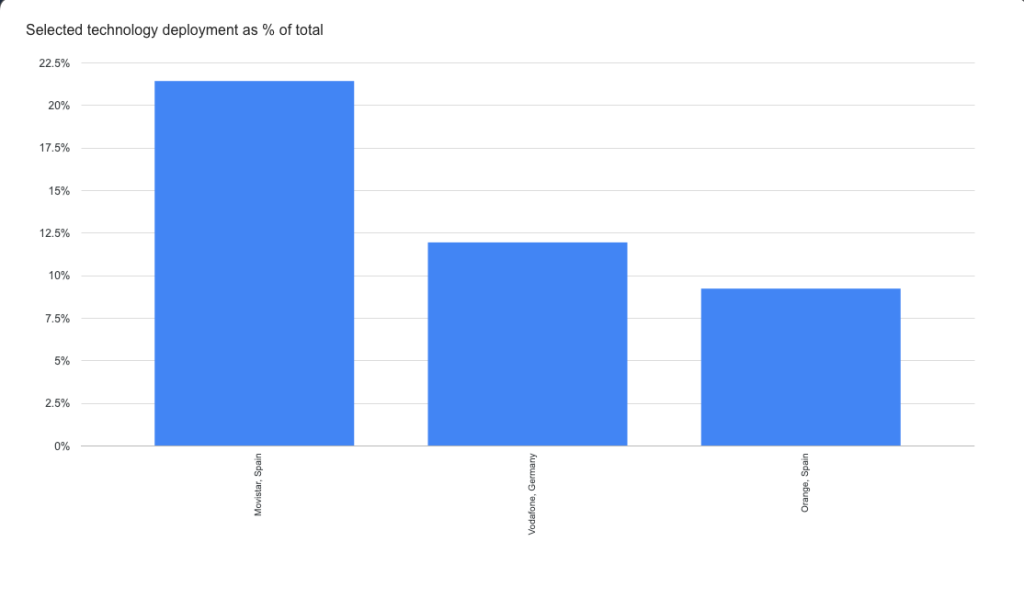
Our white paper finds that Vodafone has achieved widespread 5G deployment, but there are large variations from country to country. In Germany, 11.93% of Vodafone’s deployments use 5G standalone (SA), but in its second most 5G SA-equipped country, the UK, this drops to 4.92%.
Telefónica is a leader in 5G SA, but its deployments are strongest in its home market of Spain: 21.4% of its base station deployments in the country are 5G SA, while 31.2% are equipped for the non-SA version, which relies on the existing 4G network.
Graph showing the three highest 5G SA deployments across all four operators (Source: Mobile Deployment Database)
There is a lot of variation between the operators. Deutsche Telekom is notably the worst of the four for 5G SA deployments, but it does have a well-developed 5G non-SA network.
The German operator has deployments in six countries, yet its highest 5G SA deployment is in Hungary – just 1% of its base stations. It seems to be quite behind compared to the other operators, except for its high non-SA deployment in its other markets.
Orange is another interesting case. Although it is traditionally associated with the French-speaking world, its highest 5G SA deployment is in Spain. 9.2% of Orange’s network in Spain is 5G SA, and 35.7% is 5G non-SA.
Using PolicyTracker‘s Mobile Deployment Database, it is possible to reach several useful conclusions about the deployment strategies of these four operators. To read the white paper, click here, and to learn more about the database, click here.
To access all white papers produced by PolicyTracker about the Mobile Deployment Database, click here.
Here’s what else PolicyTracker has covered this week:
Brussels expects EU member states to find dedicated spectrum for critical communications by 2036
Italy’s lower 26 GHz auction is moving forward with an emphasis on fixed wireless access
Verizon is seeking permission to test 6G in the 4.8-4.9 GHz band in the US
Harmonisation of the 1350-1400 MHz band for PMSE is being left to individual European countries
Speakers at a recent industry event stressed the importance of resilience in spectrum management