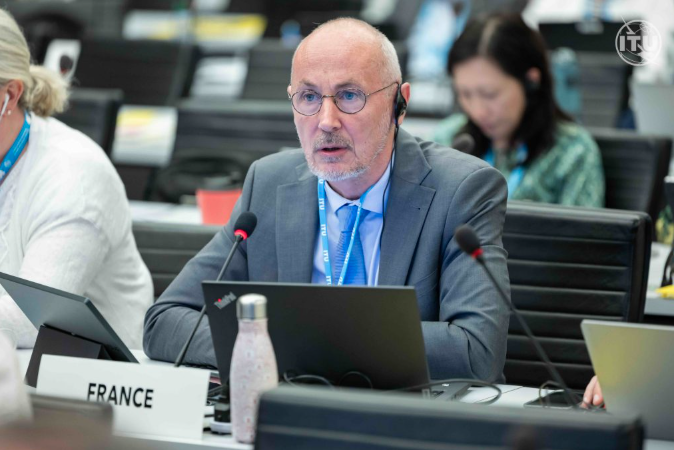
There were 94 votes for Fournier and 75 for Alexander Kühn. Candidates needed 85 to win, so no further rounds of voting were needed.
Fournier has led spectrum planning and international affairs at French spectrum agency ANFR since 2007, and has chaired CEPT’s Electronic Communications Committee and the EU’s Radio Spectrum Policy GroupRSPG stands for the Radio Spectrum Policy ….
He takes over from Mario Maniewicz, whose second and final term ends on 31 December. Before the afternoon’s voting began, the plenary paused to sing happy birthday to Maniewicz. A few hours later, the delegations chose his successor.
In his acceptance speech, Fournier pledged to uphold the multilateral framework for managing spectrum and orbits, and to work closely with the ITU’s Telecommunication Development Bureau. Repeating a campaign promise, he said the Radiocommunication Bureau (BR) and its director were there “to serve all member states in a spirit of openness, impartiality, transparency, and dialogue. Our door is always open.”
Kühn was gracious in defeat. He called it “a fair and respectful race” and said he was proud to have taken part. He also made clear he is not leaving the stage: he will continue as chair of the Conference Preparatory Meeting for WRC-27The World Radiocommunication Conference (W… and will be part of Germany’s delegation in Shanghai.
What will Fournier bring?
Speaking to PolicyTracker in August, Fournier set out a pragmatic agenda. His most pressing problem is the slow satellite filing validation process. He has said that fixing it needs more BR staff, which the ITU Council has already called for, together with efficiency gains, including through AI. He also supports a review of the WRC-2000 limits that protect geostationary satellites from constellations. He stressed that the review is a decision for ITU member states, and that his role as director is to advise.
On enforcement, Fournier’s priority is getting more member states involved in the international monitoring network rather than giving the bureau new powers. He has said he will make the case personally that non-compliance with the Radio Regulations “is not an option”.
He is no reformer of the conference cycle. He opposes more frequent WRCs. He argues that the flexibility already in the Radio Regulations has enabled satellite direct-to-device systems to start operating before WRC-27 finalises a framework for them, and that “accelerating that pace” is not what is holding back innovation. On geopolitical deadlocks, he relies on ITU-RThe International Telecommunication U… Resolution 1: “Nothing should really be blocked at working-party level.”
Fournier will be tested very soon in his new role. He takes office in January 2027 and will lead the BR into WRC-27 in Shanghai, where direct-to-device services and other contested agenda items will be discussed.
An upset for the deputy’s post
The BR vote at PP-26 followed the most dramatic contest of the week. Stephen Bereaux of the Bahamas led the race for ITU Deputy Secretary-General through three rounds, going from 59 votes to 65 and then 68. However, Bahrain’s Adel Darwish won the final run-off by 90 votes to 85, two above the required majority of 88.
Darwish’s tally had barely moved, while Brazil’s Carlos Baigorri was still in the race. Darwish obtained 55, then 54, then 51 votes. In the final run-off, he gained 36 votes while Bereaux gained 17, suggesting he acquired most of Baigorri’s support. With two candidates from the Americas dividing that region’s vote for three rounds, the arithmetic favoured the only candidate from outside it, one backed, by his own account, by the Gulf and Arab blocs.
“Wow, that was stressful,” Darwish told the hall as he opened his acceptance speech. He promised to serve “every member state in every region” and told delegates: “Thank you for your trust. I look forward to earning it every day.”
The week’s one straightforward decision came on Thursday when Doreen Bogdan-Martin was re-elected ITU Secretary-General, unopposed, with all 164 valid votes. There were four invalid ballots and five abstentions. In her acceptance speech, she promised to “listen” through disagreement, and to turn connectivity commitments into connections.
What’s next at PP-26
The Radio Regulations Board (RRB) and Council elections are scheduled for Monday 16 November from 09:30 Doha time. No board member may share a nationality with the BR Director, but France has no RRB candidate, so Fournier’s election doesn’t affect the board race. The most crowded contest is Eastern Europe and Northern Asia, with five candidates for two seats. The new Council meets in extraordinary session on 27 November.
Here’s what else PolicyTracker covered this week:
- The FCC plans to auction spectrum in the 1.6 GHz and 2020-2025 MHz bands for satellite direct-to-device connectivity
- South Africa has officially ended its wholesale open access network experiment
- Ericsson has introduced an ISAC-based drone detection system
- A new paper argues that LEONGSO, or non-geostationary satellite orbit… operators face a patchwork of interference rules, and that today’s sharing tools will struggle as more constellations launch
- European MNOs’ planned joint bid for MSSMobile-satellite service (MSS) describes a… spectrum has provoked a variety of responses