Weekly Wrap: New PolicyTracker service shows success of 5G state aid in Spain
Spain has the highest proportion of 5G standalone in Europe, according to the Mobile Deployment Database. Download our new white paper to see the detailed analysis.
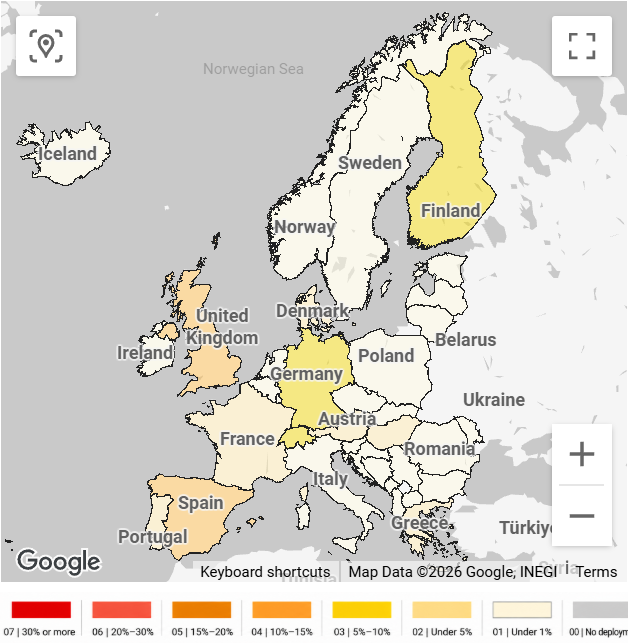
At 12%, Spain has the highest proportion of 5G standalone (5G SA) deployments of any European country, as shown by PolicyTracker‘s new Mobile Deployment Database (MDD). The UK was second with 10%, but after that the level drops substantially: all other countries had 6% or less.
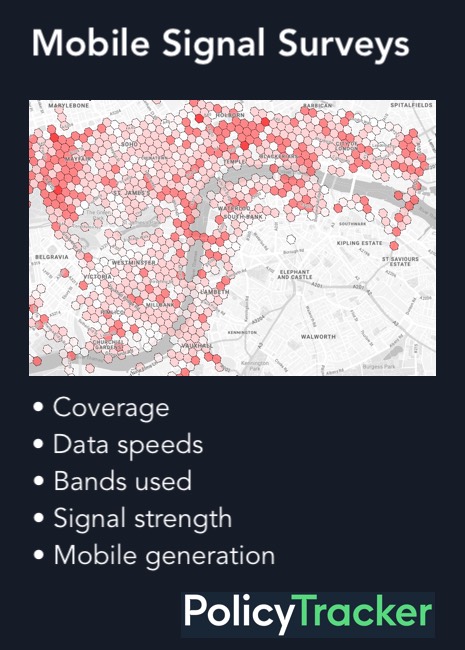
There are 43 countries in the MDD, which counts the deployment of radios in the sectors of a mobile base station by operator, band, and technology used. It is based on 2.4 billion crowd-sourced data points gathered over the past year by our partner, Teragence.
A 5G SA network uses only 5G radios and a new network computer system, unlike a 5G non-standalone network, which uses the 4G core and 4G anchor bands.
The MDD data is displayed in graphs and tables as well as maps. The map below shows the proportion of 5G SA deployed in each country.
5G SA deployment as a percentage of national deployment
Our new white paper is based on the MDD data and says that financial support from the EU via the Spanish government was a key factor in the high levels of 5G SA. In 2023, the Spanish government allocated €680 million from the EU’s post-COVID Recovery and Resilience Facility to support 5G SA in rural areas.
The white paper analyses which bands are actually deployed for 5G SA in Spain. The 700 MHz band stands out. When Spain auctioned the 700 MHz band in 2021, the government called it the most important band for 5G, brought the reserve price down to one of the lowest in Europe and doubled the maximum licence term to 40 years. The band now carries around 40% of Spain’s 5G SA radios, against a European average of 31%.
The paper argues that competitive reserve pricing in 700 MHz, extended licence duration, four-to-three mobile operator consolidation and network sharing have all played a part in 5G SA deployment. It also demonstrates that the MDD data can measure 5G SA in several ways. If the use of the high-speed 3.6 GHz band were the key criterion, then Spain would not be the winner, as it has focused on lower bands.
For more information, download the white paper and access a trial version of the MDD here.
Here’s what else PolicyTracker has covered this week:
At a recent London event, researchers and experts said 6G and more spectrum would be needed to support physical AI (such as robots) in the future
European administrations meeting in Athens this week were split on whether the 2031 World Radiocommunication ConferenceThe World Radiocommunication Conference (W… should look again at the 470–694 MHz band
Vietnam has reassigned expiring 2G spectrum licences in the 900 MHz band via auction for a total of $124 million
Muhammad Alrabeiah of Saudi Arabia’s Spectrum Advisory Group says the 7 GHz band (7125 to 8400 MHz) should be “the 6G launchpad”, while Wi-Fi should access the entire 6 GHz band
Elon Musk’s SpaceX wants the US regulator, the Federal Communications Commission, to reconsider its approval of Viasat’s latest geostationary satellite