Blog
Weekly Wrap: More countries look to IMT bands for emergency networks
Finland hopes it will have a 5G-based emergency network by 2028, Norway by 2029, and Sweden plans to follow a year or two later.
This week, I interviewed Hilde Sverdrup Müller at Norwegian regulator Nkom. She told me that the state has signed a binding agreement with the three main mobile operators, Telenor, Telia and Lyse, to update the existing Nødnett emergency network so that it will operate over 5G mobile networks.
In an increasingly unstable world, more emphasis is being placed on the need for resilient communications during emergencies
Full implementation is scheduled for 2029. This would make Norway the first country to launch a national emergency network that spans all three commercial mobile networks.
Like many other countries, Norway’s emergency network is currently based on TETRA technology, meaning that it mainly supports narrowband voice communications.
The new emergency network, asys Müller, is being designed so that it can also be used in case of war or other national crises, with additional resilience coming from the multi‑operator architecture and redundancy measures.
We wish them luck. The UK’s attempts to replace TETRA with an IMT-based emergency network have been problematic, to say the least, with multiple delays and cost overruns. However, the new Emergency Services Network (ESN) is expected to be used and tested at large‑scale events, such as the Notting Hill Carnival in August 2026, to support crowd safety and operational communications.
Finland’s VIRVE 2.0 is another example. Based on mobile operator Elisa’s commercial network, VIRVE 2.0 will see users transition from VIRVE (TETRA) to a 5G‑based broadband system, with the full TETRA phase‑out scheduled by 2028. Sweden plans to migrate public safety users from Rakel (TETRA) to LTE/5G broadband in the 700 MHz band, with full migration expected around 2030–2031.
Germany, although not planning a full TETRA replacement in the near term, is exploring the use of LTE and 5G alongside TETRA, including solutions that integrate broadband services with existing digital radio public safety networks.
The Czech Republic recently announced that O2’s Crisis Information and Call System (KISS) emergency network would now be operational in schools in the Ústí nad Labem region. The system is designed to support communication in the context of an evacuation, power outage, fire or other emergencies. Local news reported that, as of 15 April 2026, the system has been deployed in the first seven schools in the region, with more deployments planned. The goal is to reach up to 50 schools.
The O2 emergency system is already being used in public administration and healthcare, where it supports coordination in emergencies. In 2019, the Czech Republic became the first country in the world to deploy a mission‑critical LTE network in the 400 MHz band (410–430 MHz) with mobile operator Nordic Telecom.
According to the ITUThe International Telecommunication U…, with the UN World Population Prospects Report suggesting an increase of two billion people by 2050, there is a growing need for emergency networks, in particular as a result of climate change, which is causing more extreme weather events.
With climate change, communications networks at a regional or even global scale can be disrupted or destroyed. To address this, the ITU is supporting countries in developing National Emergency Telecommunication Plans (NETPs).
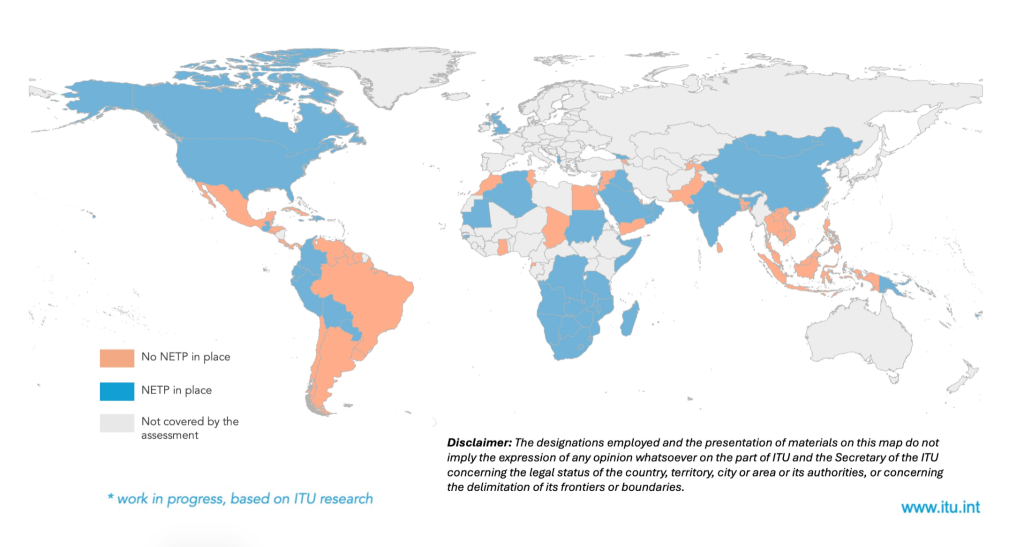
Having emergency networks that are based on mobile (IMTInternational Mobile Telecommunications (I…) spectrum bands and commercial infrastructures could prove particularly useful looking ahead, especially for countries that may not have the resources to build and maintain standalone dedicated networks. As Müller explained, however, there are still important decisions to be made on network‑sharing logistics, responsibilities and service‑level arrangements between operators and the state.
Keep an eye out for next week’s PolicyTracker article to find out more about Norway’s new emergency network – including how responsibilities are shared between Telenor, Telia and Lyse, and how resilience is being built into the design.
Here’s what else PolicyTracker has covered this week:
- Polish regulator UKE is making another attempt to assign 3.8-4.2 GHz licences to private networks
- Elon Musk’s satellite internet firm Starlink looks set to take part in the AWS‑3 auction in the US
- PolicyTracker spoke to experts from Ericsson and Nokia about what 5G‑Advanced adds to 5G and how it will affect spectrum use
- Hungary has chosen to renew rather than auction 2.1 GHz licences
- Amazon has agreed to buy Globalstar for $11.57 billion, acquiring its LEONGSO, or non-geostationary satellite orbit… constellation, ground stations and spectrum licences
By |
Camilla Mina

Experts talk spectrum.
Listen Now
Spectrum Research Service
- Dossiers new
- Benchmarking new
- Spectrum database
-
Research notes