Last week, we highlighted the increased use of hybrid licensing in the mmWave bands. One other key point that emerges from our latest research is that while regulators may be doing lots of thinking about the mmWave bands, actually awarding or making firm plans to award spectrum remains rare.
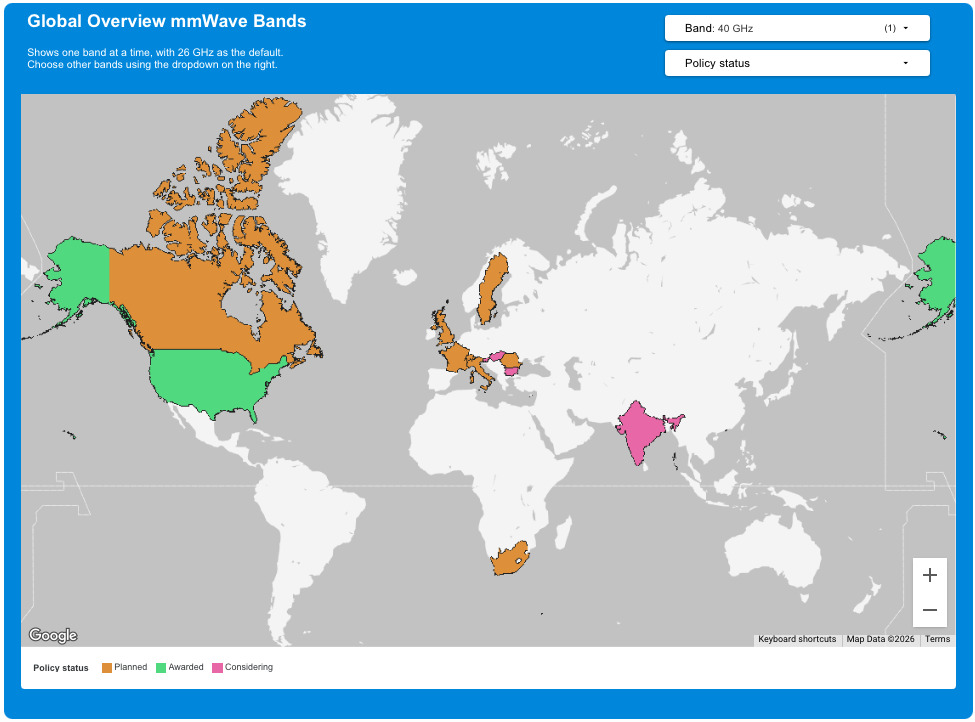
Of the countries that have awarded, are planning to award or have considered awarding mmWave spectrum, 26 and 28 GHz are the most popular bands. 63% of these countries are targeting the 26 GHz band, 18% are focused on 28 GHz, 17% on 40 GHz, and just two per cent are looking at 47 GHz.
And while 26 GHz and 28 GHz awards are rare, 40 and 47 GHz awards are rarer still, occurring in only a handful of countries.
The US is perhaps the most enthusiastic. The country has assigned spectrum not only in the 26 and 28 GHz bands but also in the 40 and 47 GHz bands by way of auctions, with spectrum licensed for use on a regional basis. The country’s 40 and 47 GHz band auction was held in 2020.
In the UK, the regulator Ofcom decided to auction some 40 GHz spectrum along with 26 GHz in 2025. All three incumbent mobile operators – EE, O2 and the newly merged VodafoneThree – each won 800 MHz of spectrum in the 26 GHz band and 1 GHz of spectrum in the 40 GHz band. The licences cover 68 “high-density” areas.
Canada, meanwhile, has assigned 28 GHz spectrum, is consulting on the release of spectrum in the 26 GHz range and is consulting on its plans to release spectrum in the 40 GHz range by way of an auction, with spectrum also licensed for use on a regional basis. South Africa is also planning to develop assignment plans for both 40 GHz and 47 GHz spectrum.
However, Australia is perhaps more representative of the views of most countries, saying in a recent “spectrum outlook” document that it would simply “monitor domestic and international developments to identify usage trends across the 40 GHz (37-43.5 GHz) 46 GHz (45.5-47 GHz) and 47 GHz (47.2-48.2 GHz) ranges”.
Most countries, when it comes to 40 and 47 GHz, have decided that their best option is to wait and see.
The full mmWave benchmark is available to PolicyTracker Research Service subscribers here.
Here’s what else PolicyTracker covered this week:
The Federal Communications Commission has dismissed petitions from SpaceX, AST SpaceMobile and Iridium to access additional MSSMobile-satellite service (MSS) describes a… spectrum in bands that already have exclusive licensees
The Swiss regulator has updated the terms of use for private networks in the 3400–3500 MHz band
The European Commission has issued a mandate to CEPTCEPT stands for the European Conference of… to assess whether the EU’s harmonised spectrum framework for the 3.4–3.8 GHz band permits integrated sensing and communications (ISAC), and to develop additional technical conditions where it does not