Where does the Mobile Spectrum Deployment Tracker source its data?
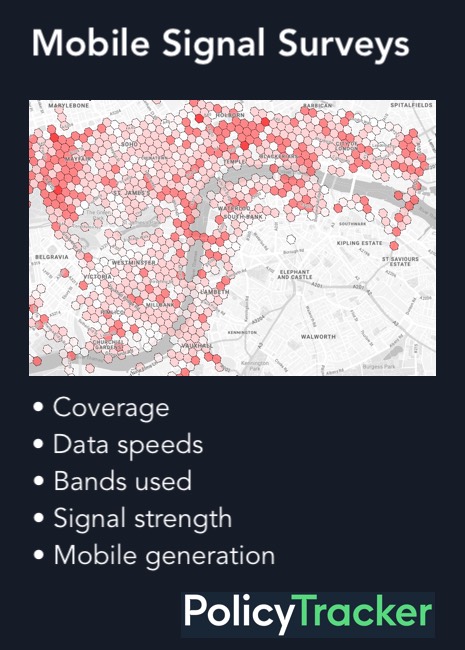
The key metric in the Teragence dataset is the sector count. This sector count is crowdsourced data from a variety of third-party mobile apps. It covers 43 countries and is updated every quarter.
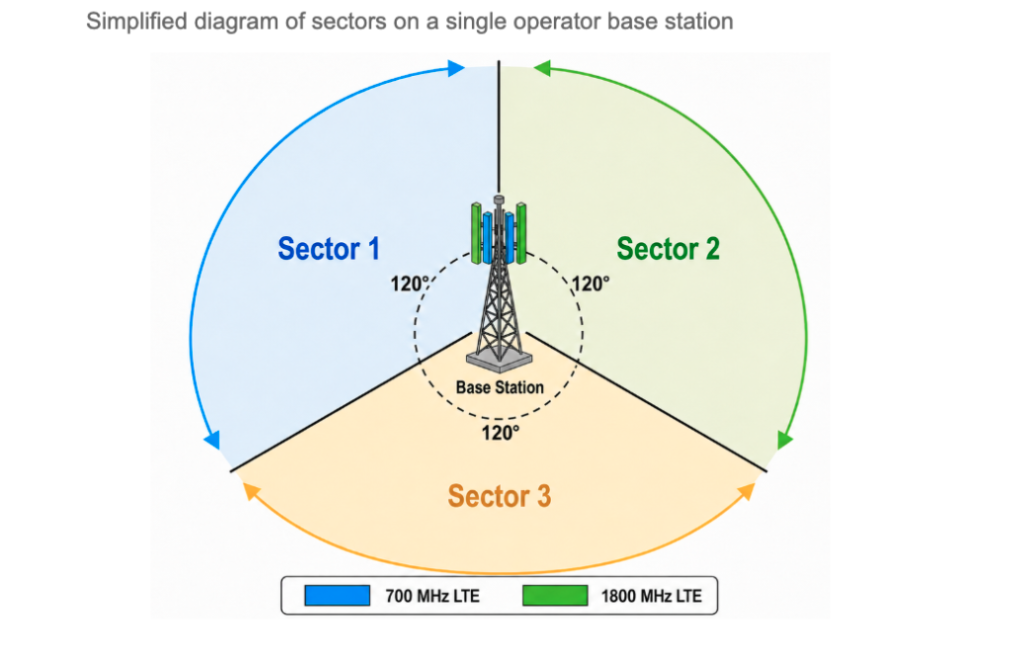
The dataset measures the number of sectors in which an operator’s transceiver is using a particular band. A sector is defined as the portion of an operator’s base station’s coverage served by a set of directional antennas and radio equipment. Most macro base stations have three sectors, each covering roughly 120°. In this dataset, each sector is specific to an operator even if the base station is shared by more than one MNO. The sector count is split up into mobile technology types and urban or non-urban areas.
What countries does the data cover?
The dataset includes all EU Member States and additional European Countries. It is linked to Teragence’s data gathering, which covers 43 countries in total.
How do page-specific filters work?
Each page applies its own set of filters to show only relevant records. Entries that do not meet a page’s criteria are automatically hidden.
What do we mean by “deployments”?
A deployment is the installation of a radio in a band, by a particular operator, using a particular technology in a sector on a base station. Most macro base stations have three sectors and band radios are typically deployed in all three sectors.
The example on the right shows a single operator base station with 700 MHz and 1800 MHz radios, both using LTE. This counts as six deployments, three in 700 MHz and three in 1800 MHz. If each sector had both an LTE and a 5G NR in both bands, this would count as 12 deployments.
If this was a shared base station where two operators had both deployed 700 MHz LTE and 1800 MHz LTE in all three sectors, this would also count as 12 deployments.
Small cells typically use a single radio in a single band e.g. 3600 MHz using 5G NR. This counts as a single deployment.
So by deployments we do not mean the number of base stations, we mean the total number of radios used. Radios used by different operators, in different bands and in different sectors are all counted separately.
What do we mean by “radios”?
We use “radio” to mean the same as “deployment”. e.g. the three 700 MHz LTE instances in the single operator base station above can be called deployments or radios.
Is “deployment” the same as “coverage”?
No, deployment just means that a radio has been installed on a base station. The data counts the number of instances of deployment and associates these with bands, operators and wide geographical areas (i.e. urban/non-urban). In the data presented there is no precise geolocation for the radio.
What technologies are covered in the data?
The data relates to the deployment of 4G, 5G NSA and 5G SA. It does not cover 2G and 3G.
How are urban and non-urban categorised?
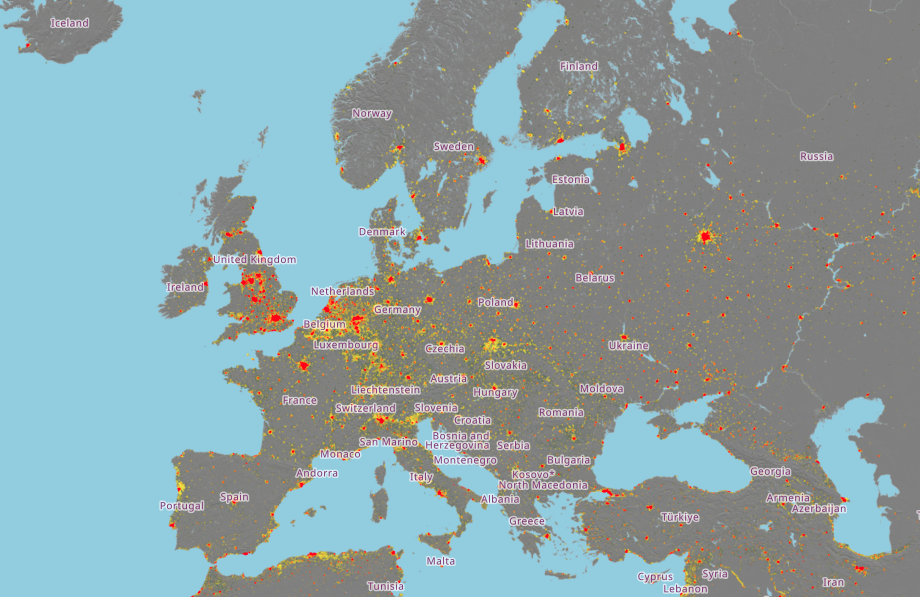
This uses the definition of Urban Centres, which comes from the EU Global Human Settlement Layer project using data from the Copernicus satellite. This defines an urban centre as ” Contiguous grid cells with high population density (at least 1,500 inhabitants per km²) and a total population of at least 50,000″, as shown in the map below.
Which bands are included?
We only show bands used for public mobile that are licensed to an operator in a particular country. These are excluded:
Licences which are not yet or no longer valid
Licence used for private networks
Licences which do not cover the whole country
How can I report missing or inaccurate data?
Email us at database@policytracker.com with the country, band, and issue details so we can investigate and update the database.
What should I do if I encounter an error?
Try clearing your browser cache and reloading. Ensure your internet connection is stable. If the error persists, please contact us at database@policytracker.com.
I’d like new features or custom analysis. How can I ask?
We always welcome suggestions on how we can make the Data Explorer better. Don’t hesitate to reach out to database@policytracker.comand tell us your thoughts. We also offer bespoke research services.
Where can I find more detailed or raw data?
Visit the full Mobile Spectrum Deployment Tracker product for comprehensive licence records, including start/end dates, detailed pricing breakdowns, and inflation-adjusted analyses. This is available as an Excel file.