Mobile UK, the trade body representing UK mobile network operators (MNOs) EE, O2, Three and Vodafone, has conceded that London “continues to lag frustratingly behind other international hubs”. That’s somewhat awkward for a capital city that markets itself as a global tech and financial centre.
This week, the BBC’s England Data Unit commissioned its own testing and found Liverpool Street and Covent Garden were among the worst-performing areas, with service collapsing during peak commuter hours but returning to normal in quieter periods.
Philip Maguire, a network surveyor who tested several Covent Garden streets on a weekday evening, reportedly found that more than one in four data tests failed outright across all four networks, with working connections often stuck below 15 Mbps. That’s bad enough to make basic tasks like loading a map or making a video call impractical in the heart of the West End.
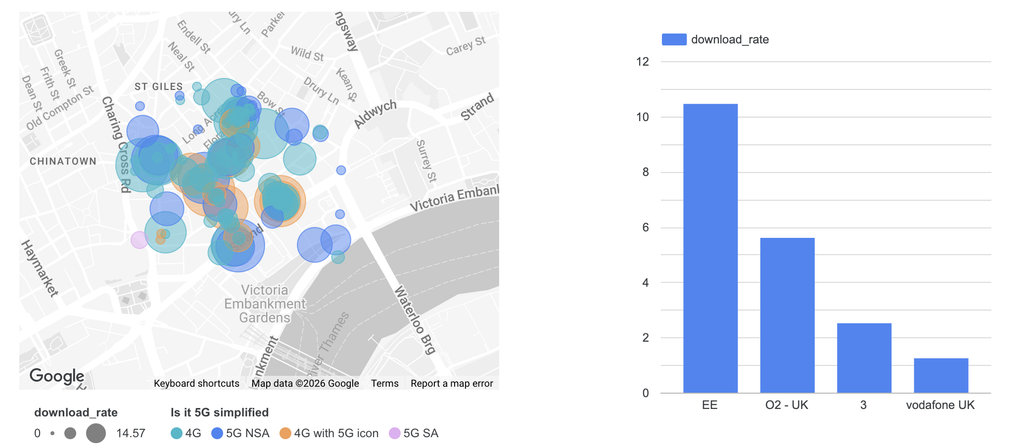
We’ve had a look at our own SignalTracker dataset, which aligns with the BBC’s test results.
Covent Garden results of SignalTracker data points (17 Sep 2026)
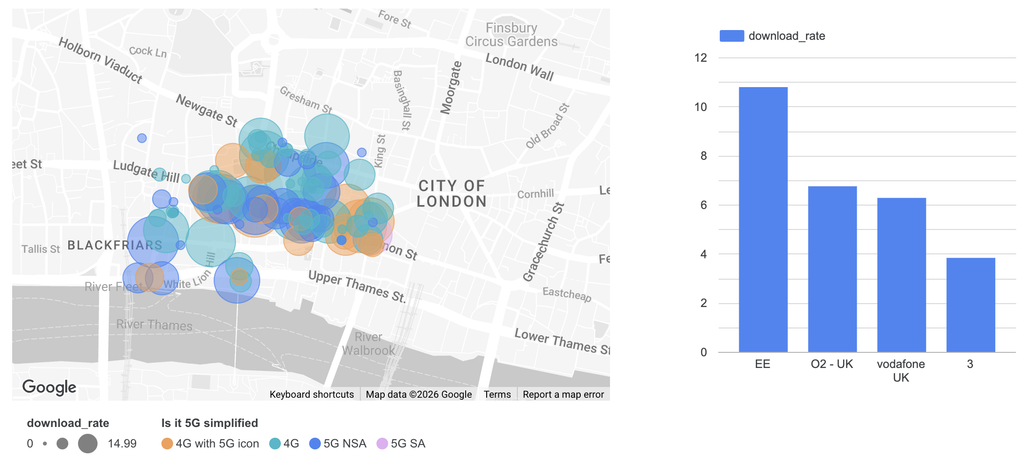
Of our signal strength and download speed readings in Covent Garden, 29% measured download speeds of less than 15 Mbps. Vodafone Three recorded the lowest download speeds. In the City of London near St Paul’s, SignalTracker data suggested that 44% of all recorded tests measured under 15 Mbps.
St Paul’s area results of SignalTracker data points (17 Sep 2026)
Mobile connectivity issues cause real-life problems. The BBC interviewed a Southwark shoe-cleaning business near London Bridge that can’t reliably take calls indoors and has to work from the doorway; a content creator in Peckham who says calls sometimes don’t connect at all despite a signal showing; and a Bermondsey-based hourly worker near St Paul’s who has lost pay because she couldn’t clock in on her phone from central London.
It’s not that there are no base stations in central London; it’s that the MNO’s network capacity can’t handle the high demand at certain times of the day. Phones show full signal bars, but calls still fail, and uploads buffer endlessly.
The key problem is infrastructure planning. Central London is constantly under construction; when a site gets building development consent, operators are given a notice-to-quit and have 18 months to find a replacement antenna site.
That’s the same in other European capitals. What’s different in London is that finding a new site reportedly takes closer to two years on average. Virgin Media O2, for example, has already had to switch off dozens of sites across London as a result. Unsurprisingly, it has called for reform.
London Councils, representing the capital’s 33 boroughs, points to the London Growth Plan and Infrastructure Framework as evidence that the issue is being taken seriously. However, rules vary borough to borough, which operators say only compounds the difficulty of maintaining continuous coverage across a single city.
Here’s what else PolicyTracker has covered this week:
UK regulator Ofcom is raising the licence fees for non-geostationary (NGSONGSO, or non-geostationary satellite orbit…) satellite gateways
Papua New Guinea is offering frequencies in the 2.6 GHz and 3.5 GHz bands directly to the country’s three mobile operators
The Australian regulator ACMA is consulting again on MSSMobile-satellite service (MSS) describes a… in the 2 GHz band
The African Telecommunications UnionThe ATU stands for African Telecommunicati… made progress on a common position on satellite direct-to-device (D2D) connectivity at its third preparatory meeting for WRC-27The World Radiocommunication Conference (W…
The DRC is to become the first African country where satellite-to-mobile services are commercially available
Laura is the News Editor at PolicyTracker. Her work is focused on spectrum policies in Europe. She has previously written for The Guardian, Deutsche Welle and several Belgian publications such as the VRT and Knack. Laura is fluent in English, Dutch and French and has a master's degree in International Journalism from City University of London.