Briefing: Verizon the biggest winner in AWS-3 spectrum auction
US mobile giant Verizon won licences covering 33% of the US in the recent AWS-3 spectrum auction, well ahead of second-place T-Mobile and third-place AT&T.
The Federal Communications Commission’s AWS-3 auction (Auction 113) ran for 72 bidding rounds from 2 to 23 June, with 200 licences in the 1695-1770/1700-2180 MHz range awarded to seven successful bidders for $3.57 billion. The licences cover around 40% of the US population.
T-Mobile won the most licences but not the most coverage
Most of this money is going towards paying off loans taken out by the FCC to fund “rip and replace” projects to replace Chinese mobile infrastructure.
The auction attracted interest from 17 qualified bidders, ranging from regional mobile providers to Elon Musk’s SpaceX.
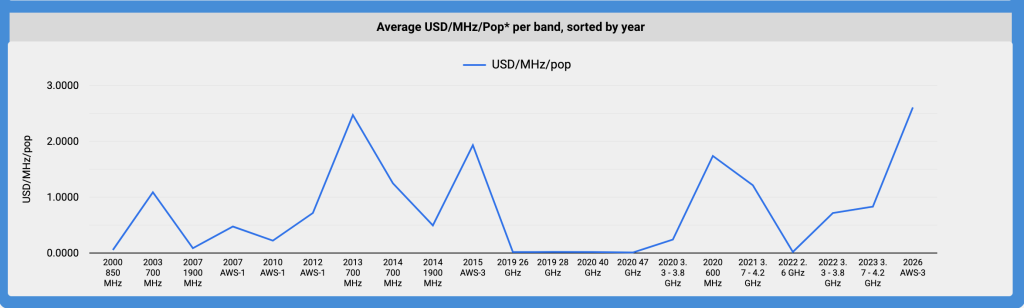
The $/MHz/Pop for this auction was around 2.6, which is far above average for an auction in the US.
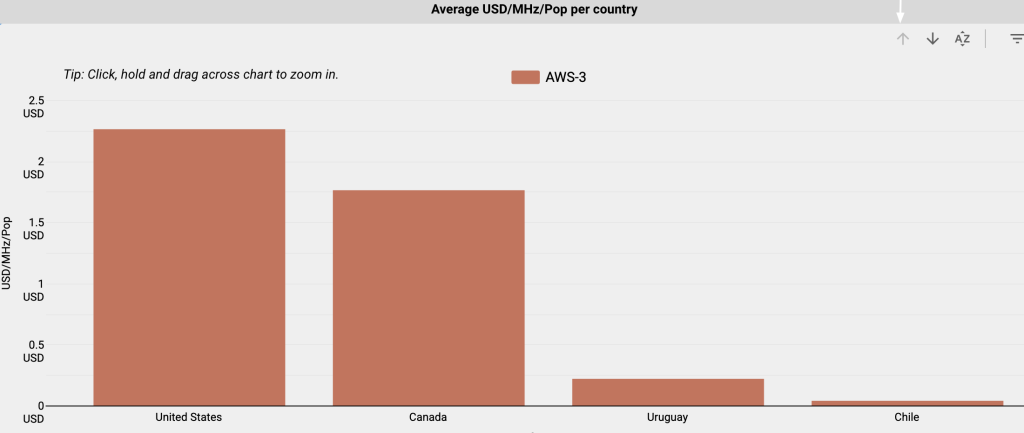
Charts from the PolicyTracker Data Explorer (available to Spectrum Research Service subscribers) illustrate how much higher this figure is than for all previous US auctions in our database.
On a global level, this auction has elevated the average $/MHz/Pop for the AWS-3 band in the US to the highest in the world. The average $/MHz/Pop in Canada is 1.7 compared to 2.26 in the US.
Subscribers to the Spectrum Research Service can consult an overview of the AWS-3 band, its pricing, where it has been awarded, and its global holdings.
The Big Three
Of the 17 qualified bidders in the auction, T-Mobile won the most licences (102) for $277,787,000. Despite winning more than half of the licences on offer, it only gained regional coverage of 7%.
SpaceX won two licences at the auction
However, increasing the population coverage of their network is not the only reason companies bid for spectrum. SpaceX and several other operators wanted licences for strategic purposes (see below).
T-Mobile was the top bidder in the states of Oregon, New Mexico, Oklahoma, Mississippi, Missouri, Kentucky, Tennessee, West Virginia, Michigan and Maine. It also obtained several licences in New York State and California.
However, the auction was controlled more by Verizon (bidding as Cellco Partnership), which won 82 licences covering 33% of the population. Verizon was the top bidder in several densely populated states with major cities – California, Washington, Texas, New York, Pennsylvania, Illinois, Florida and most of the East Coast.
Verizon won licences in Chicago (covering 8,445,866 people) and Long Island in New York (covering over 28 million people), which ranked as some of the most valuable in the auction. Verizon’s licences were more targeted at population centres, and it achieved this high population coverage figure while spending $3,162,445,000.
With 184 licences held by Verizon and T-Mobile, the remaining licences offered far less to their winning bidders in terms of population coverage. Mobile operator AT&T won 10 licences for $120,774,000, covering around 1% of the US population. It was the highest bidder in three states – Arizona, Kansas and Idaho.
AT&T’s bidding was very selective; its most significant licences were in Charlotte-Gastonia, North Carolina, and Liberty, Georgia.
Regional providers and SpaceX
There was a lot of speculation before the auction about whether satellite operator SpaceX would use it to enter the terrestrial spectrum market. Up to now, the company has had access to IMT spectrum solely through partnerships with mobile operators.
In the end, SpaceX won two licences at the auction, one of which offers population coverage of zero, as it covers the Gulf of Mexico. This is a strategic move for the company as SpaceX’s launch facility, “Starbase”, is based in Boca Chica, Texas, and the company relies on the Gulf for launch splashdowns, rocket booster test landings, and various offshore operations. It paid $8,406,000 for the licence.
The company’s other licence covers Cincinnati-Hamilton across three states: Kentucky, Indiana and Ohio. Though it covers a large population of over two million, SpaceX likely has other reasons for obtaining it.
Echostar/Dish was bidding mainly for strategic reasons
This region has been targeted for the construction of several multi-million-dollar data centre projects. With XAi having recently merged with SpaceX, the company has probably obtained this spectrum licence in anticipation of benefits for its AI projects.
Of the various small regional providers that competed in the auction, only two managed to successfully acquire licences. In American Samoa, the Citizens Band License Company won a licence covering no more than 50,000 people on the island.
Similarly, Blue Ridge Wireless, a small regional provider, obtained one licence in the Davenport-Moline area covering around 55,000 people. Due to the high bids from T-Mobile and Verizon, there were few licences left for small operators.
Role of Echostar/Dish
Another bidder that took part for strategic reasons was Echostar/Dish.
197 of the 200 licences auctioned were originally owned by Dish. The (large) company used two subsidiaries, Northstar Wireless and SNR Wireless, to access small company bidding credits at an AWS-3 auction held in 2014. The FCC took legal action, and Dish was ordered to return the licences.
Dish has been taking legal action of its own in recent years to try to get the licences back and to overturn the $515 million of penalties it had to pay the FCC. Echostar, following its merger with Dish, has inherited these issues.
A $2.9 billion default penalty was incorporated in the AWS-3 auction rules, meaning if auction proceeds fell under this level, Echostar would have to pay the difference to the FCC.
Analysts have argued that Echostar used Conundrum Wireless to raise the price during the AWS-3 bidding process to keep it out of the default payment territory. Conundrum obtained two licences on Guam and seems to have stopped bidding in the auction as soon as proceeds exceeded the penalty threshold.
PTI Pacifica and Docomo Pacific, genuine bidders on Guam, dropped out, likely due to the inflated price of the licences.
The chances of a network being built on Guam seem slim, as Echostar/Dish recently wrote to the FCC offering to sell the licences held by its many subsidiaries in exchange for build-out condition waivers•