Earlier this year, PolicyTracker completed its latest survey of key stakeholders in the spectrum world. As usual, it included profiles of 15 of the world’s most important mobile network operators (MNOs), featuring a breakdown of their spectrum holdings (Deutsche Telekom’s are below) and other important data.
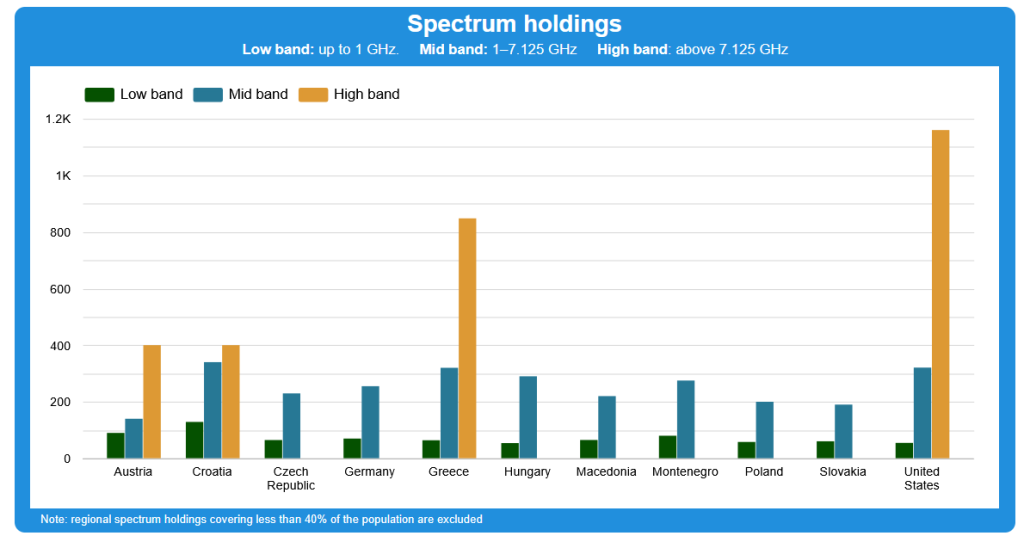
Deutsche Telekom’s spectrum holdings (Source: PolicyTracker Spectrum Database)
The key trend we picked up on was that after a few years of trials, MNOs are now starting to include satellite connectivity options in their subscription portfolios.
In late 2025, for example, Orange moved beyond trials to launch “Message Satellite 2025″, a Skylo-powered NTNNon-terrestrial Networks (NTN) are wireles… (non-terrestrial network) service which offers direct-to-device (D2D) messaging and location services in areas that lack mobile coverage.
However, it’s still early days – service is currently only available to Orange France mobile customers with eligible 5G or 5G+ subscriptions.
Elsewhere in the world, restructuring is the name of the game. Telefónica, for example, has exited Colombia and Chile after previously exiting various Latin American countries, including Argentina, Peru, Uruguay and Ecuador. Vodafone has sold off its Italian and Spanish operations and merged its UK unit with Three UK.
Upgrades to 5G standalone (SA) – the full version of 5G, where both the radio network and the core network are built using 5G technology – are also getting off the ground. Deutsche Telekom has nationwide 5G SA deployment in Germany, and it is live in Austria, Greece and Hungary. Orange has commercially deployed 5G SA in several markets. And while 5G progresses, 2G and 3G are gradually being switched off.
An overview of the key trends among MNOs is now available to PolicyTracker Research Service subscribers, along with the individual profiles.