Blog
Weekly Wrap: The fight over MSS spectrum is in full swing
Last week, Reuters reported that Amazon is in talks to buy Globalstar in a deal valued at around USD 9 billion. I had a closer look at what spectrum licences Globalstar actually holds, and what is really at stake in any acquisition.
Globalstar has put itself up for sale. Its board and major shareholders appear to see a short window to sell while satellite‑and‑spectrum assets are in high demand, before Starlink‑scale constellations and satellite‑IoT networks erode the standalone value of a niche MSSMobile-satellite service (MSS) describes a… operator.
If Amazon does buy Globalstar, Band 53/n53 and the MSS spectrum would likely be folded into Amazon LeoNGSO, or non-geostationary satellite orbit… to build a hybrid satellite‑plus‑terrestrial broadband service
Globalstar’s main licensed spectrum falls into two buckets: its mobile‑satellite service bands and its terrestrial 2.4 GHz holdings. In the US, it is licensed in the L/S‑band satellite ranges 1610–1618.725 MHz and 2483.5–2500 MHz, with a small overlap segment shared with Iridium at 1617.775–1618.725 MHz. Apple’s Emergency SOS via Satellite uses Globalstar’s licensed 2.4 GHz infrastructure, and Apple owns a 20% stake in the company, taken as part of a USD 1.5 billion investment in 2024.
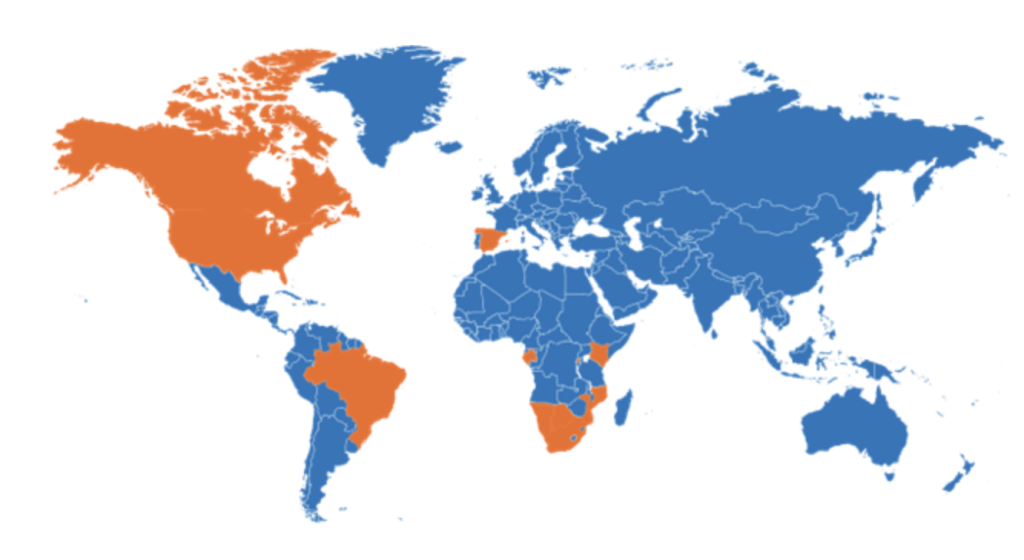
The terrestrial spectrum assets are of particular value. Globalstar has licences in Band 53 and its 5G variant n53, which covers 2483.5–2495 MHz and is, according to the company, licensed in 11 countries including the U.S. and Canada. Today it is used as a licensed, interference‑protected channel for LTE and 5G small‑cell and private‑wireless networks, rather than as a consumer‑grade mobile band.
If Amazon does buy Globalstar, Band 53/n53 and the MSS spectrum would likely be folded into Amazon Leo to build a hybrid satellite‑plus‑terrestrial broadband service. Sitting next to 2.4 GHz Wi‑Fi and being globally harmonised, the band is well‑suited to low‑interference, high‑density indoor or campus deployments—an obvious fit for Amazon’s warehouses, retail‑tech and logistics‑IoT use cases.
But none of this is straightforward. The transaction is only at the discussion stage, and one of the biggest hurdles is Apple’s 20% stake and its strategic reliance on Globalstar capacity. Any Amazon move would have to navigate Apple‑related commercial and governance issues as part of the deal.
Starlink recently put itself on the FCC’s list of interested bidders for the June re‑auction of leftover AWS‑3 licences … alongside AT&T and others
Another reality is that even with Globalstar, Amazon would still be far behind Starlink in satellites and subscribers, so this would be a strategic boost rather than an instant catch‑up. Since 2019, SpaceX has launched just over 11,500 Starlink satellites in total, with a little over 10,000 currently in orbit; Amazon has launched about 200. That asymmetry is now feeding into a more confrontational phase at the FCC.
That confrontation is not only about how many satellites are in orbit but also about who controls key terrestrial bands. Starlink recently put itself on the FCC’s list of interested bidders for the June re‑auction of leftover AWS‑3 licences (1695-1710 MHz, 1755-1780 MHz, and 2155-2180 MHz ranges), alongside AT&T and others.
What’s more is that the latest FCC filings show how quickly this fight is spilling into orbital‑safety policy. Earlier this month SpaceX accused Amazon and launch partner Arianespace of inserting Amazon Leo satellites 50–90 km above the ~400 km altitude described in their approved debris‑mitigation plan, “without adequate coordination or information sharing,” forcing Starlink to perform around 30 collision‑avoidance manoeuvres within hours of a February launch.
Amazon’s response calls the allegations “disingenuous,” noting that a 450 km insertion altitude was disclosed to FCC staff and reflected in multiple space‑safety reports, and pointing out that SpaceX itself launched Amazon satellites to similar heights in 2025 without raising objections.
The Globalstar discussions, Starlink’s scale, and Amazon–SpaceX’s combative FCC filings all point in the same direction: the real battle over satellite spectrum and orbits is only just beginning, and regulators that still treat MSS as a niche service should start paying attention.
Here’s what else PolicyTracker has covered this week:
- Ukraine updates frequency plan to prepare 700 MHz assignment
- Costa Rica’s Constitutional Chamber has cancelled Sutel’s auction of radio and TV spectrum over media pluralism concerns
- The EU has launched the first satellites in its new Celeste low‑Earth‑orbit constellation to strengthen Europe’s satellite navigation
- APG‑27 chair Nobuyuki Kawai has outlined key hurdles for WRC‑27 agenda items 1.7 and 1.13, covering new IMTInternational Mobile Telecommunications (I… identifications and MSS direct‑to‑device services
By |
Laura Sear
Laura is the News Editor at PolicyTracker. Her work is focused on spectrum policies in Europe. She has previously written for The Guardian, Deutsche Welle and several Belgian publications such as the VRT and Knack. Laura is fluent in English, Dutch and French and has a master's degree in International Journalism from City University of London.
Experts talk spectrum.
Listen Now
Spectrum Research Service
- Dossiers new
- Benchmarking new
- Spectrum database
-
Research notes