Blog
Weekly wrap: Satellite updates from MWC26 Barcelona
Following major releases, online conversations and the keynote speeches this week, my main take is that satellite direct-to-device (D2D) technology has taken centre stage and will remain there for years to come. Also, the impact of geopolitical unrest was clear in the conference halls.
Some were perhaps expecting a satellite telco announcement from Elon Musk’s satellite firm this week. Instead, Michael Nicolls, Senior VP for Starlink, used the show to tease its Mobile V2 constellation, with about 1,200 satellites planned initially.
Mobile V2 should be able to deliver “5G speeds” of up to about 150 Mbps, using the 3GPP3GPP stands for the Third Generation Partn… NR‑NTNNon-terrestrial Networks (NTN) are wireles… standard, the MSSMobile-satellite service (MSS) describes a… spectrum acquired from EchoStar, and is expected to work with most smartphones.
Nicolls said the service was meant to complement terrestrial networks, so that mobile network operators (MNOs) can “invest less in terrestrial networks while unlocking seamless service in remote areas and enabling total coverage everywhere”.
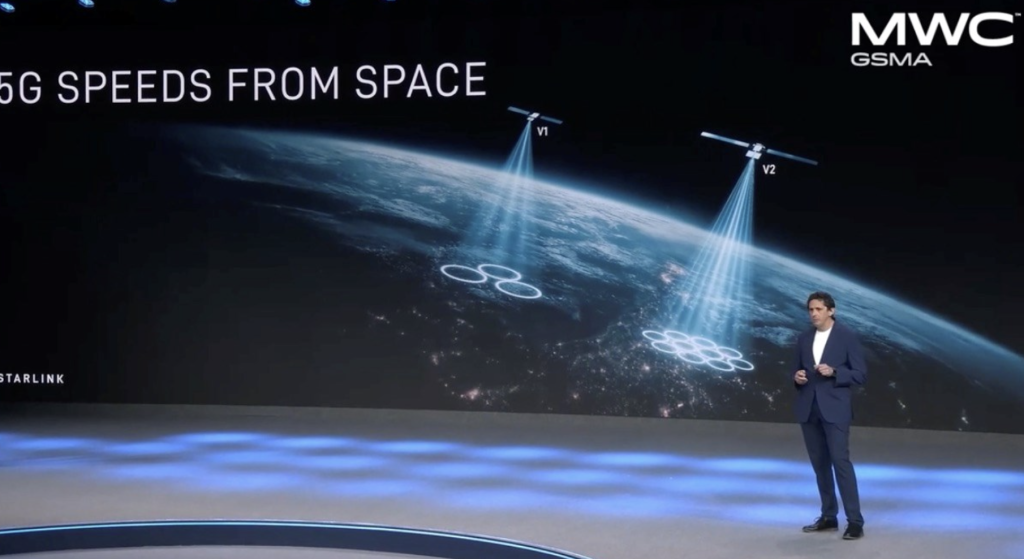
During his keynote, Nicolls also announced that Deutsche Telekom would use Starlink’s current V1 satellites to offer D2D connectivity to around 140 million of its subscribers across 10 European countries.
Another MWC26 headline announcement was the launch of Satellite Connect Europe (SCE). It is centred on Vodafone’s open‑access joint venture with AST SpaceMobile, which Orange and Telefónica have now also joined. “We’re here to complement, not compete – and it’s a powerful model that’s gaining traction,” said SCE’s Meredith Sharples.
The two announcements point to two distinct European D2D models: a Starlink–DT camp built around a tightly integrated global satellite network, and a Vodafone/Orange/Telefónica camp built around SCE’s open wholesale platform. The Starlink camp is essentially buying into a single vertically integrated system for coverage extension, while the SCE camp emphasises European control, multi‑operator access and a more neutral wholesale role for the satellite layer.
Mobile industry association the GSMA provided some reality checks during the D2D sessions. “Even in an unlikely scenario of a 42,000-satellite constellation and access to every MHz of terrestrial IMTInternational Mobile Telecommunications (I… bands, D2D could still deliver basic 2 Mbps service to around 12% of the global population—and 20 Mbps to less than 2%,” said Ross Bateson and Peter Jarich.
“Signal loss from space and limited spectrum reuse (with spot beams spanning 25–50 km versus terrestrial cells of hundreds of metres) define the ceiling of D2D’s capability, and it was stressed that these limitations should be clear to policymakers trying to make the best use of the service.”
Geopolitics at MWC
The conference was affected by the conflict in the Middle East. The GSMA confirmed that “scores of delegations from South‑East Asia, Australia and South Africa” withdrew after airspace in Israel, Iran and several Gulf states was shut, blocking the long‑haul links used to reach Barcelona. A Xiaomi India representative told Catalan media that “between 20 and 30% of my colleagues haven’t been able to arrive in Barcelona.”
Against that backdrop of disrupted travel and rising geopolitical tension, the mobile industry’s growing focus on defence and security feels logical.
This was illustrated when Tom Rondeau from the FutureG Office at the US Department of Defense and Mike Woster from the Linux Foundation announced the OCUDU Ecosystem Foundation as a public‑private hub for an open RAN architecture. They explicitly linked it to 6G trajectories and pitched it as a “foundational reference platform for RAN, including AI‑based algorithms and solutions”.
This edition of MWC gave me the sense that future connectivity is being designed not just for new services, but for a more contested world.
Here’s what else PolicyTracker covered this week:
- Japanese mobile network operator au has 3.5 million users for its satellite D2D service
- Lithuanian regulator RRT is preparing an auction of 700, 1500 and 2100 MHz spectrum
- Nigeria’s regulator wants to clear the 600 MHz band of broadcasters and assign it to mobile network operators by the end of 2027
- The Australian regulator wants standardised mobile coverage maps to improve how mobile operators present coverage information to consumers
- The French Senate has denounced the shutdown of 2G/3G networks because of a lack of consultation
- Finland is to reduce DTT spectrum in 600 MHz band
- EU member states have until 30 September 2026 to implement harmonised technical conditions for the 3.8-4.2 GHz band, marking a major step towards a unified framework for private networks
By |
Laura Sear
Laura is the News Editor at PolicyTracker. Her work is focused on spectrum policies in Europe. She has previously written for The Guardian, Deutsche Welle and several Belgian publications such as the VRT and Knack. Laura is fluent in English, Dutch and French and has a master's degree in International Journalism from City University of London.
Experts talk spectrum.
Listen Now
Training
Understanding Modern Spectrum Management
An overview of the key engineering, legal and policy issues
Read more
Spectrum Research Service
- Dossiers new
- Benchmarking new
- Spectrum database
-
Research notes