Weekly Wrap: It won’t be “winner takes all” in European UHF band
I attended a workshop on the future of the 470-694 MHz band in Copenhagen, Denmark this week. The event convinced me that compromise is essential to prevent the scramble for UHF spectrum from leaving every incumbent worse off.
Any debate about the contested 470-694 MHz band tends to follow a familiar pattern. The digital terrestrial TV (DTT) and programme-making and special events (PMSE) sectors, for example, will fight for their positions as incumbents. They argue that moving them out of the band would be devastating, reckless and a regulatory headache.
The mobile industry, meanwhile, is staking its claim to the 600 MHz band to serve rural communities, pointing to the digital divide and to demand for spectrum that outstrips supply. The defence sector wants access to the band as the geopolitical outlook grows more troubling, and PPDR (public protection and disaster relief) use is increasingly on the table: recent floods in Europe and disasters elsewhere have highlighted the value of reliable emergency communications.
These battle lines are well established, but the tone in Copenhagen this week, at a CEPTCEPT stands for the European Conference of… workshop on the future of UHF, was noticeably different. There were sparks – notably when the economic value of DTT was questioned amid its (heavily) disputed decline, and when it was suggested that a US-style “special temporary authorisation” could ease the difficulties facing PMSE users – but the overall mood was one of compromise.
CEPT’s FM51 working group is making steady progress on its 470-694 MHz “toolbox” for “flexible use” of the band. In essence, this would enable countries to tackle coexistence according to their own conditions, economic factors and circumstances.
As I learned at the workshop, several countries are going their own way. More than 85% of Italy’s TV is delivered by DTT rather than satellite, for example, and DTT coexists with streaming, with audiences using both rather than dropping one in favour of the other. Finland, meanwhile, is moving ahead by making 614-694 MHz available for 5G/6G testing, keeping 470-614 MHz for TV and enabling PMSE use across the band from January 2027.
Regulators wanting to introduce mobile into the band may eventually be able to do so with the FM51 toolbox, even if their neighbours take a different approach. The mobile industry’s argument has increasingly moved in this direction: that coexistence with broadcasting and other users is achievable once studies have been completed and regulatory measures undertaken.
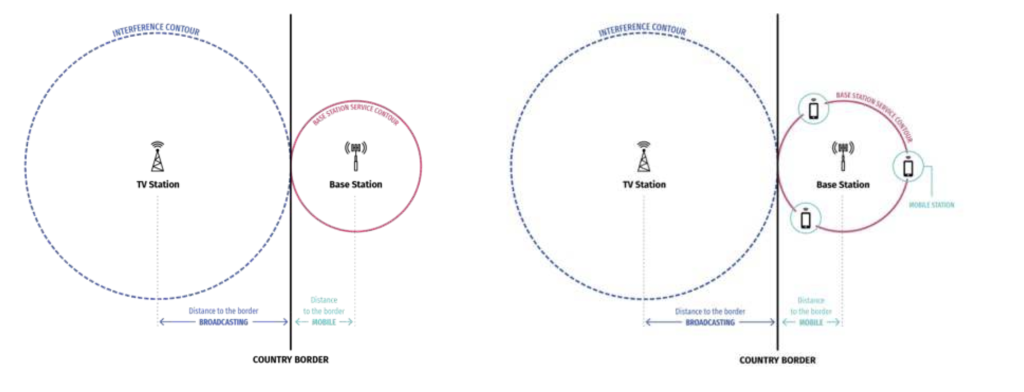
A diagram from a recent GSMA report showing how DTT and IMT coordination could work across a border (click to access the report)
PMSE users in particular still broadly oppose this, but as one regulator put it during a panel session at the event, “there will be some hurt; not everyone can have it their own way”.
What compromise will look like remains vague, but that was why the event was needed: to make regulators feel empowered to take the UHF band into their own hands, and to make them recognise how varied conditions are across CEPT member states.
As 2030, the year legal protections for DTT and PMSE expire, draws ever closer, sharing the “hurt” now feels inevitable. The resolve is there; let the negotiations begin.
Here are the other stories PolicyTracker covered this week:
A draft European Parliament report on the Digital Networks Act proposes that part of each newly harmonised mobile band should be assigned at EU level to operators meeting “strict resilience and sovereignty criteria”
The Swedish regulator has granted the Swedish Civil Defence Agency permission to use frequencies in the 700 MHz band that were previously used for digital terrestrial TV
Stakeholders are divided over the UK regulator Ofcom’s proposals for the future of the 2 GHz MSSMobile-satellite service (MSS) describes a… band
Singaporean operator Simba has been using spectrum that had not been assigned to the company
PolicyTracker spoke to UK regulator Ofcom, France’s ANFR and US regulator the FCC about EPFD limits reform