Weekly Wrap: The UK doesn’t want much more spectrum for 6G
Ofcom published its call for input on WRC-27 preparations this week, setting out preliminary UK positions on all items up for negotiation at next year's conference in Shanghai.
The document runs from satellite Earth station connectivity to lunar communications, but only three agenda items carry Ofcom’s declared “high” priority rating.
Two of those are fairly easy to explain. Under agenda item 1.17, the UK is asking for new allocations to protect space weather sensors. That position relates to the UK Met Office’s role in running one of just three global space weather prediction centres.
Agenda item 1.13 covers D2D connectivity, where the UK is backing an international framework that lets satellites talk to ordinary mobile handsets without degrading the terrestrial networks they’ll be sharing spectrum with. That position is not a surprise and is in line with the domestic D2D decision Ofcom took last year.
We remain unconvinced that a clear case for more spectrum has been made
The third, agenda item 1.7, is the one worth looking at more closely. It covers “future mobile broadband spectrum”, the identification exercise that is meant to hand 6G its next round of frequencies. Previously, at WRC-19, 5G was handed the 700 MHz band, C-band and bandwidth in the mmWave bands.
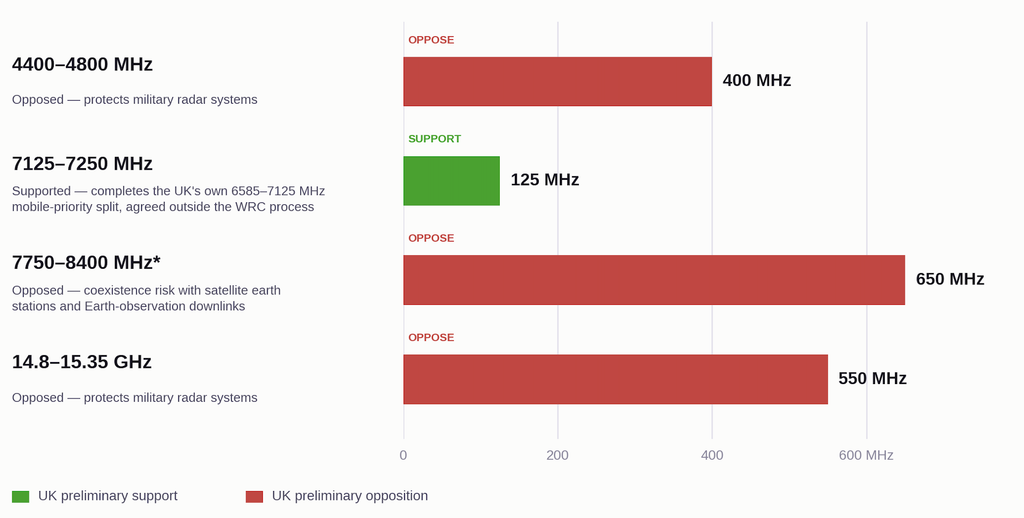
In 2027, three candidate ranges are on the table: 4400-4800 MHz, 7125-8400 MHz and 14.8-15.35 GHz. Ofcom’s preliminary position opposes an IMTInternational Mobile Telecommunications (I… identification in three of them, citing risks to military radar systems in the first and third, and coexistence problems with satellite Earth stations and Earth observation downlinks in the second.
That leaves 7125-7250 MHz, just 125 MHz in total, as the only band under this agenda item that the UK currently wants identified for mobile.
UK preliminary position on WRC-27 Agenda Item 1.7. The UK supports mobile use of just 7% of the 1725 MHz under consideration. Source: PolicyTracker
The UK has already decided, outside the WRC process, to make 6425-6585 MHz available for Wi-Fi and to prioritise 6585-7125 MHz for mobile. Identifying the next 125 MHz at WRC-27The World Radiocommunication Conference (W… would simply close the gap to a clean boundary and align CEPTCEPT stands for the European Conference of… with a decision the UK has already taken.
Ofcom is candid about why it isn’t asking for more. “The UK, in line with the CEPT position, did not support this Agenda Item being included on the agenda for WRC-27 at WRC-23, and we remain unconvinced that a clear case for more spectrum has been made,” the UK regulator said.
That argument stands in stark contrast to years of mobile industry lobbying for substantially more mid-band and upper-mid-band spectrum for 6G than 5G ever used, with the 7-15 GHz range regularly pitched as the next frontier.
According to Ofcom’s consultation, that case has not been made, or at least not across the three bands up for discussion. Whether that scepticism survives the rest of the CEPT process before WRC-27 opens in Shanghai is the main topic to watch over the next year.
The GSMA wants mobile network operators, manufacturers and regulators to work together to ensure users can make emergency calls amid a global shutdown of 2G and 3G networks
Swiss regulator ComCom has dropped its proposed frequency-portfolio mechanism for a multiband auction to be held next year, opting instead for tighter spectrum caps
The sale of T-Mobile’s 800 MHz spectrum portfolio to a private equity firm is now complete after getting the green light from the US regulator
Poland’s Ministry of Digital Affairs has drafted a regulation modifying the country’s spectrum allocation table, including provisions for mobile use of the 6 GHz band
Laura is the News Editor at PolicyTracker. Her work is focused on spectrum policies in Europe. She has previously written for The Guardian, Deutsche Welle and several Belgian publications such as the VRT and Knack. Laura is fluent in English, Dutch and French and has a master's degree in International Journalism from City University of London.