New PolicyTracker research highlights ascendancy of hybrid mmWave licensing
The new edition of PolicyTracker's mmWave benchmark shows that a combination of national, regional and local licences is favoured by over 60% of countries.
PolicyTracker‘s latest research into regulatory approaches to mmWave spectrum is based on a dataset which covers 148 licences or proposed licences in 58 countries.
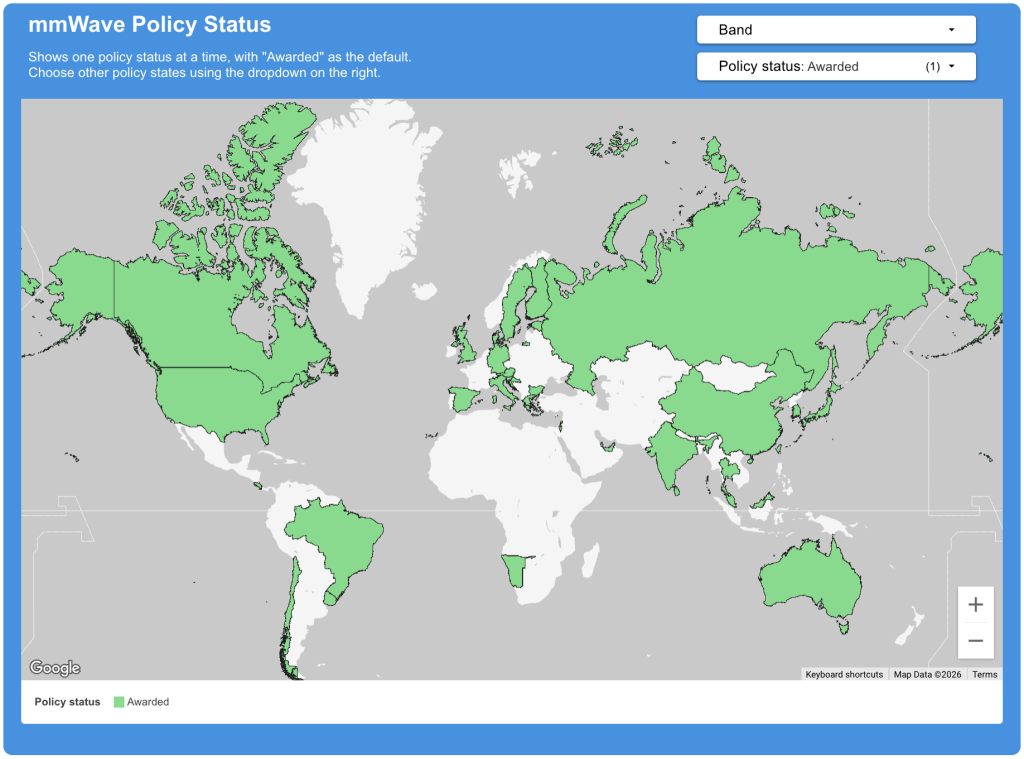
It shows slow progress in releasing mmWave bands with only 36 countries on board so far, even though the first 5G award was made eight years ago in South Korea. Recently, several countries, including Poland, Belgium and Iceland, have delayed mmWave awards due to a perceived lack of demand.
Countries which have awarded at least one mmWave band
For a harmonised mobile band, a lack of interest from the industry is an unusual problem. Our research shows that regulators’ most common strategy is to depart from the typical approach of making mobile licences national and exclusive. 62% of the countries in our research have adopted a hybrid approach, awarding local or regional licences to encourage use by industry verticals as well as national licences.
And for some of the countries that have awarded national licences, their land mass is so small that a local or regional approach does not seem necessary or practical. To put this into perspective, the US awards regional mmWave licences as it does with most other mobile bands. These are based on over 400 “partial economic areas” (PEAs), and the smallest one of these on the US mainland is twice the size of the national licence that Singapore has awarded for mmWave.
In simple terms, many of the licences awarded by those countries taking a “national-only” approach to mmWave are geographically smaller than some being awarded as regional licences in the US. For example, PEA 26 (Las Vegas and surrounding areas), one of the larger, but not the largest, US mmWave licences, covers a bigger area than seven of the countries that have adopted a “national-only” approach. Detailed figures are below.
Taking landmass into account highlights how uncommon it is for regulators in larger countries to issue national-only mmWave licences; a hybrid approach, including geographic sharing, is the more popular option. This reflects the poor propagation characteristics of the band and the hope that vertical use may compensate for the mobile industry’s misgivings.
Comparing national-only mmWave licences against PEA licences in the US
Examples of PEA licences
Countries with a national-only approach to mmWave licences
Here are the stories PolicyTracker covered this week:
Brazil has auctioned regional licences in the 700 MHz band
Industry bodies in Europe have been having their say on the Radio Spectrum Policy Group’s 6G spectrum roadmap before it is finalised later this year. The mobile industry is happy, the PMSE sector less so
Interference in a slice of the 800 MHz band used by IoT devices that generated over 120 complaints was caused by a robot lawnmower, says the French spectrum agency ANFR
Spectrum assigned to French mobile operator SFR is to be shared between the three other national operators as part of a €20.35 billion deal
Colombia is to award local licences in the 900 MHz band to community groups and regional ISPs
The PolicyTracker team wishes you a tremendous weekend!