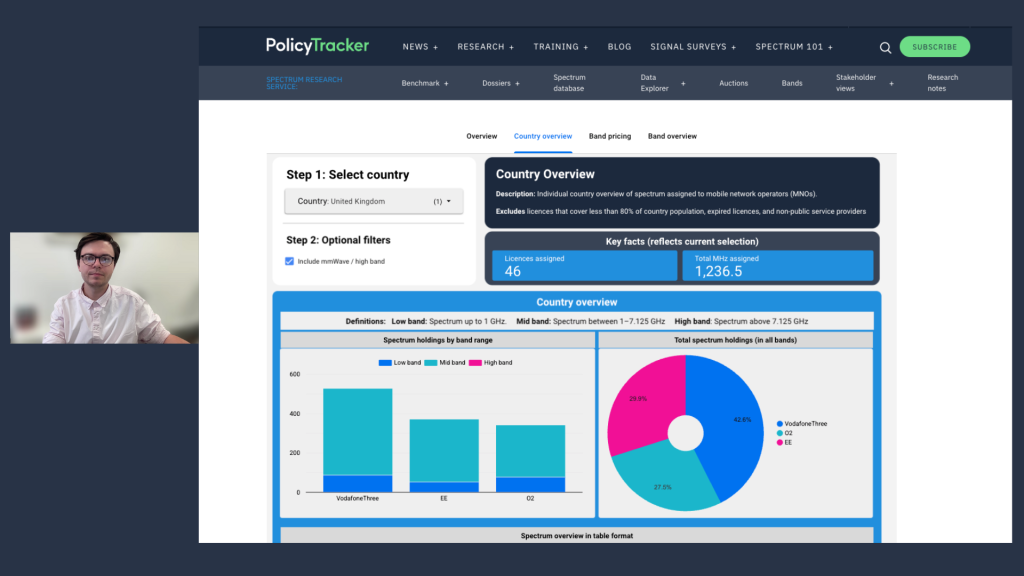
In mid-September, PolicyTracker is launching its new and improved Data Explorer. This interactive database will enable subscribers to view our data in new and innovative ways.
Shortly after the launch, we will be hosting a webinar on Tuesday, 23 September, between 15:00 and 16:45 CET, to demonstrate what the new Data Explorer can do. The webinar will be held online and is free to attend. Sign up here.
It will be hosted by PolicyTracker’s lead data analyst Richard Haas, who will explain why we made the new tool and how it works. Any questions will be answered at the end of the session.
The new Data Explorer will provide a new way for users to browse our industry-leading data on spectrum licences and pricing from around the world, based on an interactive web-based interface. It enables you to answer quick questions you may have about a particular country or spectrum band, such as:
Which German mobile operator has the largest spectrum assets?
Has China or the US made more mid-band spectrum available?
What’s the average price for 700 MHz spectrum?
How has the price of 26 GHz spectrum changed over time?
Once launched, the Data Explorer will be available to all Spectrum Research Service subscribers. The new tool is just one of many ways we have improved our Research Service in 2025.
Turkey announced that it would hold an auction of 700 MHz and 3.5 GHz spectrum in October.
India has published a wide-ranging policy document, which includes several references to spectrum and its role in policy-making.
A new joint US-India Earth observation mission will begin operations soon, with scientists looking to use a blend of L-band and S-band spectrum to collect data.
Argentinian regulator Enacom is making 2.3-2.4 GHz spectrum available for 5G private networks.
Splitting 6 GHz between licensed and low-power unlicensed use offers a pragmatic solution for the band that balances innovation, public revenue, and industrial needs, says Roslyn Layton.
Richard is a journalist and analyst at PolicyTracker. Apart from writing about spectrum policy news, his main responsibilities include maintaining the PolicyTracker Spectrum Database and producing the Spectrum Podcast. Richard is fluent in English and German.


You can see a recording of the Data Explorer webinar here: https://www.policytracker.com/help/data-explorer-help/