Weekly Wrap: GSM-R meltdown shows need for upgrade
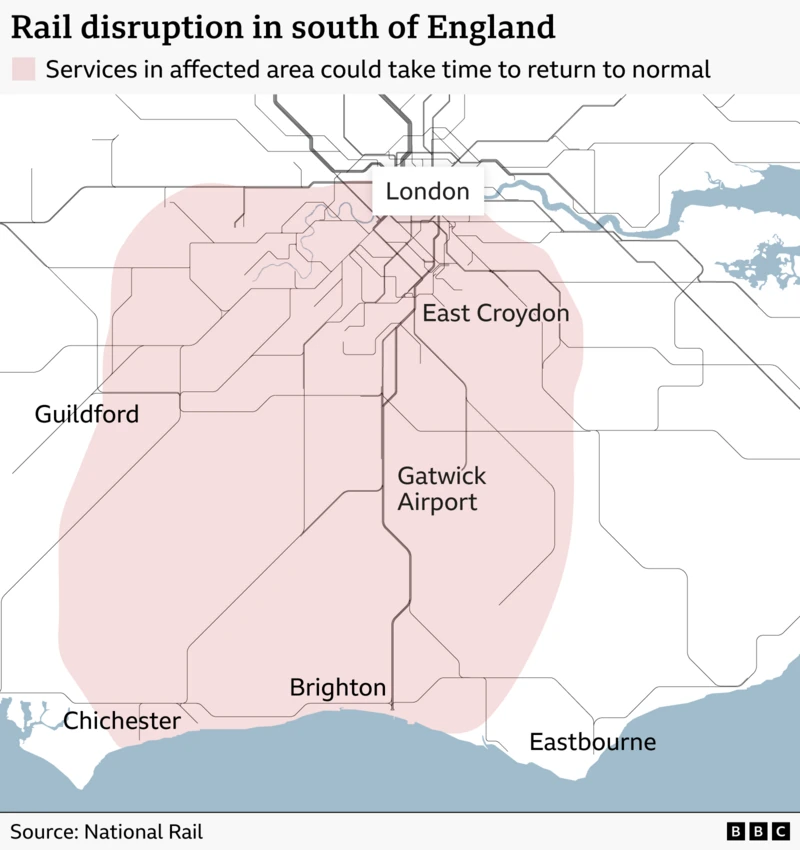
This week's disruption across southern England, triggered by a fault in the radio system linking train drivers and signallers, offers an unusually clear example of something that is normally invisible to passengers: how dependent modern railways have become on mobile networks.
Railway engineer Gareth Dennis told the BBC that GSM‑R, the system used across the UK and much of Europe, was “a radio technology that lets train drivers and signallers speak to each other” and is treated as a safety‑critical tool for stopping trains in an emergency.
When that link is in doubt, the only responsible course is to limit or stop services until engineers are confident that drivers can receive instructions and that emergency calls will get through.
GSM‑R’s widespread adoption has long been one of its strengths. Standardised under ETSIThe European Telecommunications Standards … and the International Union of Railways (UIC), and deployed with harmonised spectrum at 900 MHz, the network made stable and interoperable voice and data communications possible in Europe.
That stability is now facing growing technical issues. GSM‑R is built on 2G foundations that the wider mobile ecosystem has largely abandoned, leaving railways exposed to hardware issues, shrinking vendor support and rising cybersecurity concerns. The UIC and European rail bodies have warned that GSM‑R support will wane towards the end of this decade, with practical end‑of‑life expected around 2030.
The Future Railway Mobile Communication System (FRMCS) is intended to be the remedy. Developed by the UIC in cooperation with ETSI and 3GPP3GPP stands for the Third Generation Partn…, FRMCS uses 5G‑derived technologies to provide a single platform for mission‑critical voice, data and future applications. In principle, it should be able to support everything GSM‑R does today while adding the bandwidth and latency performance needed for automatic train operation and new safety and efficiency tools. European work on spectrum has converged on dedicated bands at 900 MHz (3GPP band n100) and 1900 MHz as the primary bands for FRMCS.
The migration path, however, is complicated and long. The UIC UGFA migration white paper envisages overlapping operation of GSM‑R and FRMCS for many years, with different possibilities for sharing or separating spectrum and for using hybrid architectures. Equipment is therefore likely to carry dual‑mode terminals; infrastructure managers face the task of designing networks and procedures that preserve safety even when one of the two systems is degraded.
Yesterday’s disruption provided a sense of what is at stake in that design work: the aim will not only be to avoid catastrophic outages, but also to ensure that any failure degrades capacity gracefully rather than forcing wholesale shutdowns.
This week’s incident arrived right in the middle of this transition debate in the UK. Network Rail’s CP7 plan already assumes that the current GSM‑R network will need to be upgraded to a 5G‑based FRMCS platform within the next decade, and work is underway on migration scenarios and funding. The regulator, Ofcom, has meanwhile decided to make the 1900–1910 MHz band available for operational rail communications from 2029, explicitly identifying FRMCS as the long‑term use and aligning the UK more closely with Europe’s spectrum model for rail.
Against that backdrop, the major disruption in southern England will probably be seen as a reminder that the window for a transition to FRMCS is narrowing.
As operators and regulators discuss timelines, funding models and spectrum allocations for FRMCS, the images of passengers queueing at Waterloo and students missing classes provide a concrete narrative about why resilient, modernised rail communications are no longer just a back‑office concern. The question has shifted from whether GSM‑R can be kept going a little longer to how quickly the railway can move to a platform designed for the demands and expectations of the next few decades.
Here’s what else PolicyTracker has covered this week:
Australia has set new voluntary rules for altimeter protection
A committee of the US House of Representatives is attempting to block a petition to reconfigure the 900 MHz band for NextNav’s position, navigation and timing network
The US regulator has accepted proposals that will see a new system introduced in the country to replace the ITU’s current interference protections for satellites in geostationary orbitObjects in the GSO, or Geosynchronous Orbi…
Mobile industry association the GSMA wants European regulators to reduce or eliminate fees on the more than 500 spectrum licences due for renewal between 2025 and 2035
Laura is the News Editor at PolicyTracker. Her work is focused on spectrum policies in Europe. She has previously written for The Guardian, Deutsche Welle and several Belgian publications such as the VRT and Knack. Laura is fluent in English, Dutch and French and has a master's degree in International Journalism from City University of London.
On the GB mainline railway today, GSM‑R provides a safety-critical communications link between driver and signaller rather than being a train control system. Moving-block operation remains a future ETCS concept rather than an operational reality. Historically, train control was fulfilled through a mixture of semaphore signals, coloured lights and in some cases physical tokens – methods that were simple, robust and worked without complex back-end systems.
The more pertinent question today is not the extent to which GSM‑R has replaced those systems, or how quickly FRMCS can be brought in, but how much residual capability the modern railway retains to operate safely when the radio link is (occasionally but unavoidably) unavailable. On the evidence of recent disruptions, that margin appears to be rather slim, with very little slack left in the timetable.
The transition from GSM-R to FRMCS clearly demonstrates that railway communications are evolving into critical digital infrastructure requiring resilient, future-ready, and spectrum-secure communications platforms.
The recent UK disruption further highlights the operational risks associated with aging 2G-based mission-critical systems and reinforces the importance of accelerating migration toward modern IMT/5G-based railway communication networks.
From a regulatory and spectrum management perspective, this transition raises important considerations regarding harmonized spectrum, coexistence frameworks, long-term licensing models, and mission-critical network resilience requirements.
Within the Arab Spectrum Management Group (ASMG), there is also growing interest in studying future railway communication evolution, including FRMCS-related developments and the importance of regional and international spectrum harmonization to support interoperable, secure, and future-proof railway connectivity ecosystems.




On the GB mainline railway today, GSM‑R provides a safety-critical communications link between driver and signaller rather than being a train control system. Moving-block operation remains a future ETCS concept rather than an operational reality. Historically, train control was fulfilled through a mixture of semaphore signals, coloured lights and in some cases physical tokens – methods that were simple, robust and worked without complex back-end systems.
The more pertinent question today is not the extent to which GSM‑R has replaced those systems, or how quickly FRMCS can be brought in, but how much residual capability the modern railway retains to operate safely when the radio link is (occasionally but unavoidably) unavailable. On the evidence of recent disruptions, that margin appears to be rather slim, with very little slack left in the timetable.
The transition from GSM-R to FRMCS clearly demonstrates that railway communications are evolving into critical digital infrastructure requiring resilient, future-ready, and spectrum-secure communications platforms.
The recent UK disruption further highlights the operational risks associated with aging 2G-based mission-critical systems and reinforces the importance of accelerating migration toward modern IMT/5G-based railway communication networks.
From a regulatory and spectrum management perspective, this transition raises important considerations regarding harmonized spectrum, coexistence frameworks, long-term licensing models, and mission-critical network resilience requirements.
Within the Arab Spectrum Management Group (ASMG), there is also growing interest in studying future railway communication evolution, including FRMCS-related developments and the importance of regional and international spectrum harmonization to support interoperable, secure, and future-proof railway connectivity ecosystems.
Riyad Ehlayel TDRA-UAE