Blog
New dossier on coverage and quality of service
This dossier examines how regulators worldwide monitor coverage and quality of service (QoS) to ensure operators are adhering to their licence conditions.
The benefits of accurate coverage and service data are manifold. They can reveal where bands are congested, underused, or suffering from interference, allowing regulators to reassign frequencies, adjust licence obligations and encourage investment in capacity exactly where it is needed.
Detailed coverage and QoS data also make it possible to verify compliance with rollout and performance obligations, target remedies to genuine not‑spots rather than modelled ones, and support more flexible approaches such as sharing or dynamic access in bands that are not fully utilised. The more precise and timely these measurements are, the better regulators can balance competing demands, reduce waste, and ensure that every MHz delivers maximum socio‑economic value.
This dossier is a deep dive into the network measurements and includes the following research notes:
- Overview of mobile signal measuring challenges
- Approaches of the US, Australia and Japan
- Approaches of the UK, France and Germany
- Third-party data gathering services
Regulators use a mix of tools to measure mobile coverage and service quality, including model-based coverage maps, drive and walk tests, fixed probes and crowdsourced data, as seen for example in the UK, where the regulator, Ofcom, combines operator submissions with its own field campaigns and user experience data to assess 4G and 5G performance.
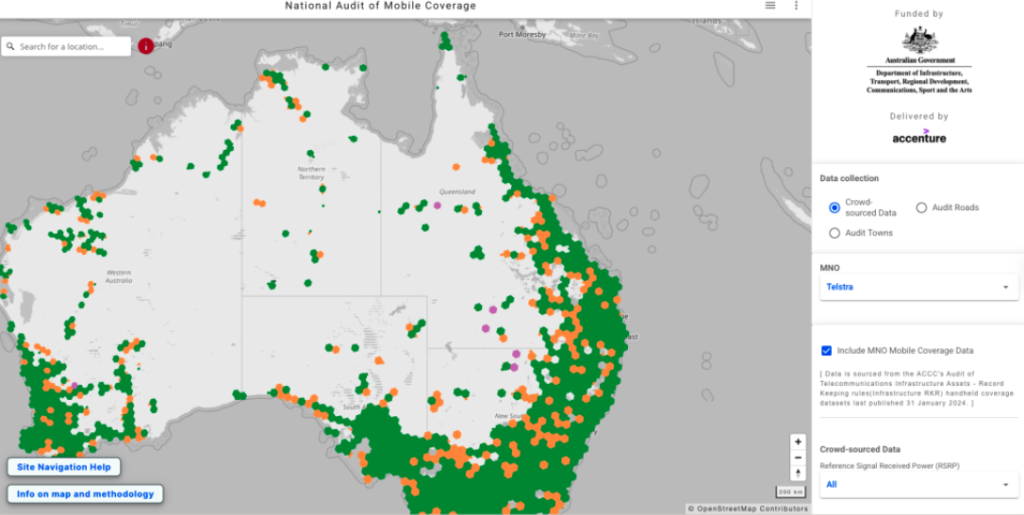
In Japan, the Ministry of Internal Affairs and Communications relies on operator reports and standardised field measurements to check that ambitious 5G coverage obligations are being met. However, all of these approaches have inherent shortcomings, from cost and limited geographic reach to sampling bias and dependence on operators’ inputs.
Alongside regulators, large commercial analytics firms such as Ookla and Opensignal collect vast amounts of network performance data through SDKs (software development kits) embedded in consumer apps and sell insights and benchmarking services to operators and other industry clients.
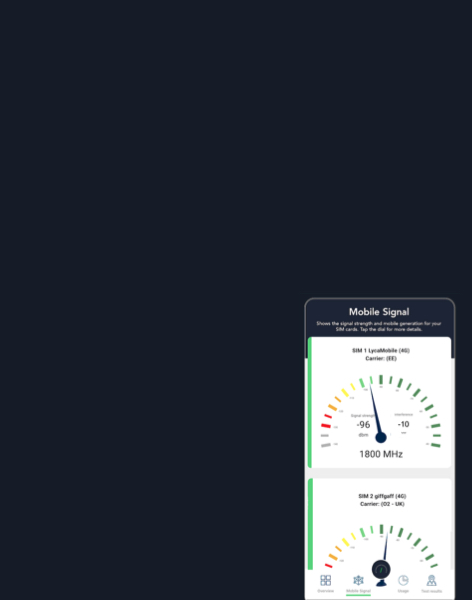
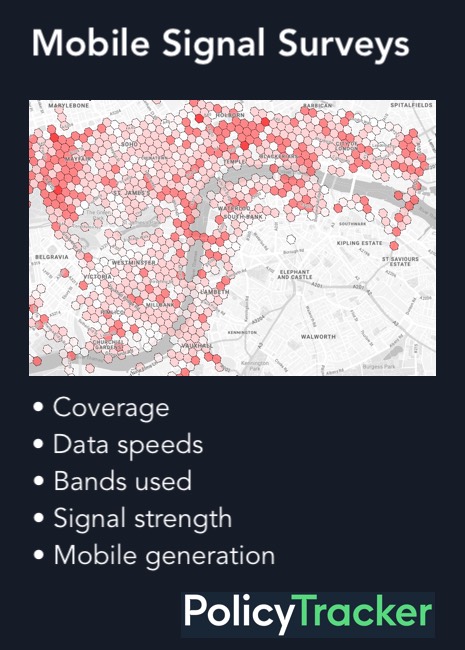
There are also small, independent and more explicitly ethics‑focused initiatives like SigCap and PolicyTracker’s SignalTracker, where data volumes are much smaller but collection is transparent, community‑driven and free from direct mobile operator commercial interests.
The new dossier on coverage and QoS is now available to Spectrum Research Service subscribers.
By |
Laura Sear
Laura is the News Editor at PolicyTracker. Her work is focused on spectrum policies in Europe. She has previously written for The Guardian, Deutsche Welle and several Belgian publications such as the VRT and Knack. Laura is fluent in English, Dutch and French and has a master's degree in International Journalism from City University of London.
Experts talk spectrum.
Listen Now
Training
Understanding Modern Spectrum Management
An overview of the key engineering, legal and policy issues
Read more
Spectrum Research Service
- Dossiers new
- Benchmarking new
- Spectrum database
-
Research notes